Fandom
The Autograph Line Is A Marketplace With Unwritten Rules
Signing tables at American conventions run on posted prices, timed sessions and handlers, and the etiquette that governs the line exists because the arithmetic of the day is unforgiving.

A signing table at an American convention looks like a casual meeting and operates like a small retail counter. Almost every element of it, including the pace, has been decided in advance.
The table is a booked business, not a courtesy
Guests at large conventions are contracted, and appearance fees are a real cost that the organizer recovers somewhere. Signing revenue is usually one of the places it gets recovered.
That is why prices are posted on a card rather than negotiated, and why photographs, personalizations and item signings are often priced separately. The list exists to keep the line moving.
Handlers sit beside the table for the same reason. Their job is throughput and safety rather than gatekeeping, and they absorb the awkwardness of ending a conversation politely.
Arithmetic sets the pace of the line
A session is scheduled in a window, and the number of people who can pass through it is simply the window divided by the time each interaction takes. Nothing else changes that.
An extra thirty seconds per person, multiplied across a long line, removes dozens of people from the end of it. Convention staff are watching that math the whole time.
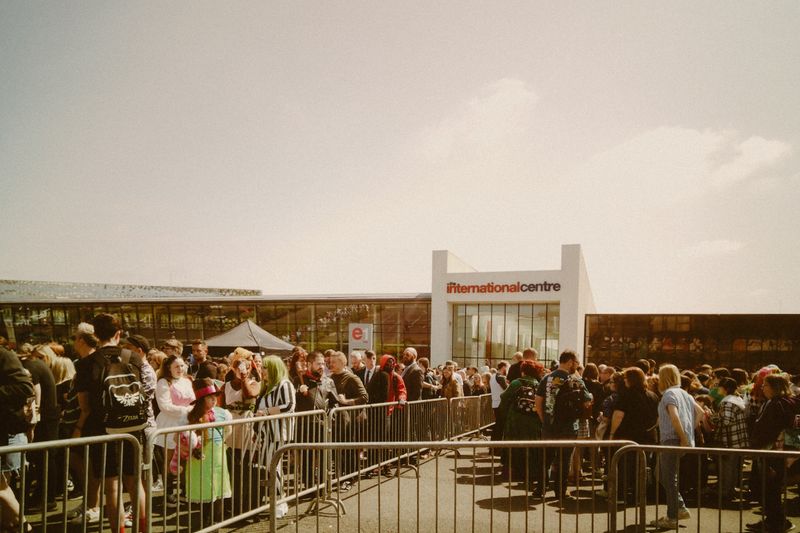
Fans in the line learn to compress: item out, name ready, one question, move. The etiquette is not deference, it is an informal agreement to protect the people standing behind you.
Authentication grew out of a resale problem
Signed items have resale value, and a signature has no inherent proof of origin once it leaves the room. That gap created an entire authentication industry around convention floors.
Witness services now stand at tables, watch the signing happen and attach a numbered tag to the item. What is being sold is observation, not expertise about handwriting.
The presence of resellers also shapes limits on quantities and on which items can be signed. Organizers are trying to keep the session about attendees rather than inventory.
Photo operations are a separate industrial process
Posed photographs are usually run away from the signing table, on a backdrop with a fixed light setup and a photographer working continuously. The rhythm there is faster still.
Attendees are moved through in seconds because the operation prints or delivers digitally at volume. That efficiency is what makes the price point possible at all.
It also explains why the interaction feels brief in a way the table does not. One is a queue built for conversation, the other is built for a shutter.
The unwritten rules travel between events
Because the same guests, handlers and vendors circulate across many American shows, conventions in different cities converge on similar practices without any central authority writing them down.
Regulars carry the norms with them and teach newcomers in the line, which is why a first-timer is usually corrected gently rather than confronted.
The result is a code that is genuinely communal in origin but commercial in purpose, and both halves are visible if you stand in the line long enough to watch it work.
Questions readers ask
Can a film be designed as a cult film?
Attempts are frequent and almost always fail. The status depends on an audience discovering something for themselves, which a deliberate strategy tends to prevent.
Does streaming make cult status easier or harder?
Both. Availability is broader, which helps discovery, but works disappear unpredictably and the shared experience of a screening is harder to replicate.
Also by Harsha Vardhan
- Foley is a person in a room pretending to be your footsteps, and real sound will not doHow It Is Made
- Previsualisation turned expensive guesswork into a rough cut made before shootingHow It Is Made
- Dubbing and subtitling are two different arguments about what a performance isHow It Is Made
- The first assistant director runs the day, and the schedule is a creative documentHow It Is Made