Television
Daily drama runs on a schedule that would break any other kind of television
Continuing serials produce more finished material per year than almost any other format. How that is possible is a genuine feat of industrial organisation.

These are listed in the order worth acting on, which with continuing serial production is not the order they are usually presented in.
What matters most
- Scripts, shooting and editing all run continuously and in parallel rather than in phases.
- Standing sets and fixed camera setups remove most of the daily decision-making.
- The format sustains large permanent crews and is a major training ground for the industry.
The volume problem
A continuing serial may deliver several episodes every week for decades, which is a quantity no conventional production model can supply. That requires every stage to run simultaneously, with scripts being written for episodes that will shoot months after ones currently in the edit.
Storylines are planned far ahead by a dedicated team, then broken into episodes and distributed to writers on a rolling schedule. Shooting happens on a fixed weekly pattern using permanent sets, which removes the setup time that dominates other productions. The result is an industrial process closer to manufacturing than to the project-based structure of most film and television.
Why standing sets matter so much
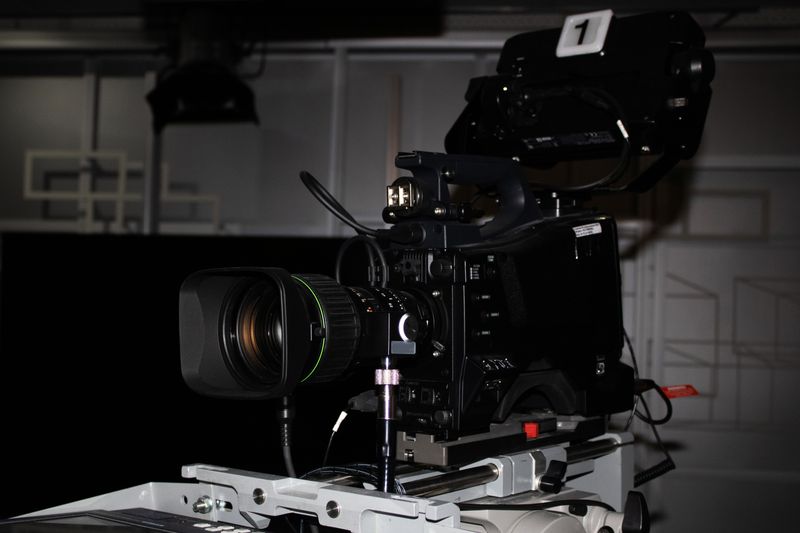
Permanent sets can be permanently lit, with lighting rigs positioned once and adjusted only slightly thereafter. That alone saves hours per scene, which across a week's output amounts to entire additional episodes. Camera positions become standardised too, so operators and directors are working from an established plan rather than devising coverage.
On the call sheet, the predictability extends to performers, who know exactly how a scene in a familiar room will be shot before arriving. This is why continuing serials look consistent and why they can absorb new directors with minimal disruption.
Writing at that pace
Long-term story planning is separated from episode writing, so a serial has both an architecture team and a delivery team. Individual writers receive a document specifying what must happen in their episode and write the scenes that achieve it.
That division allows enormous throughput while maintaining continuity across storylines that run for a year or more. It also constrains individual expression, which is why serial writing is often undervalued despite being technically demanding. Writers who train in this environment tend to be exceptionally reliable elsewhere, because they have learned to deliver on schedule.
Handling cast availability
With a permanent cast working year-round, absences for illness, holiday and other commitments are constant and must be planned around. Storylines are built with the flexibility to write a character out temporarily without disrupting anything else. That flexibility is why serials have so many parallel storylines: they function as redundancy as much as as variety.
It also explains the format's use of long absences with in-story explanations, which is a scheduling solution rather than a plot idea. Managing this across dozens of regulars is a planning problem of real complexity that receives almost no critical attention.
What the format does for the industry
Continuing serials employ large permanent crews, which is unusual in an industry organised around temporary project teams. That stability makes them a significant training ground, where directors, writers and technicians learn at high volume. A great many people working across television began in continuing drama, which is where speed and reliability are acquired.
The format also supports regional production centres, since a permanent base requires a permanent facility somewhere. These effects are considerable and are rarely mentioned in discussions of the format's cultural standing.
Attribution is difficult on collaborative work, and a credit is not the whole story.
Why the form is underrated
Serials are judged by sampling, and any single episode of a continuing story is a poor representation of the whole. The format's real achievements are cumulative: character histories spanning decades and community structures no other form can build. Its constraints are also invisible, so what looks like conventional staging is frequently a solution to an impossible schedule.
Watching a serial attentively for a month reveals a craft that a single episode conceals almost completely. That is a fair test to apply before dismissing the most demanding production model in television.
Everything above, in order of what to do first
- The volume problem. A continuing serial may deliver several episodes every week for decades, which is a quantity no conventional production model can supply.
- Why standing sets matter so much. Permanent sets can be permanently lit, with lighting rigs positioned once and adjusted only slightly thereafter.
- Writing at that pace. Long-term story planning is separated from episode writing, so a serial has both an architecture team and a delivery team.
- Handling cast availability. With a permanent cast working year-round, absences for illness, holiday and other commitments are constant and must be planned around.
- What the format does for the industry. Continuing serials employ large permanent crews, which is unusual in an industry organised around temporary project teams.
- Why the form is underrated. Serials are judged by sampling, and any single episode of a continuing story is a poor representation of the whole.
The takeaway
Judge a continuing serial on a month of it, because a single episode is a page from the middle of a book.
The premise gets you in. The structure decides whether you stay.
Questions readers ask
How far ahead are serials planned?
Long-term story planning typically runs many months ahead, with individual episodes written closer to shooting. The exact lead times vary by production.
Why do serials use so many parallel storylines?
Partly for variety and partly for redundancy, since a storyline can be paused if a performer is unavailable without stopping the episode.
Also by Vaishnavi Rao
- The unbroken take is a scheduling problem long before it is a stylistic oneFilm & Screen
- Development hell is not one problem — it is six, and they take turnsFilm & Screen
- The second act is where films fall apart, and the reason is structuralFilm & Screen
- A soundstage and a location ask completely different things of an actorFilm & Screen